Title Photo

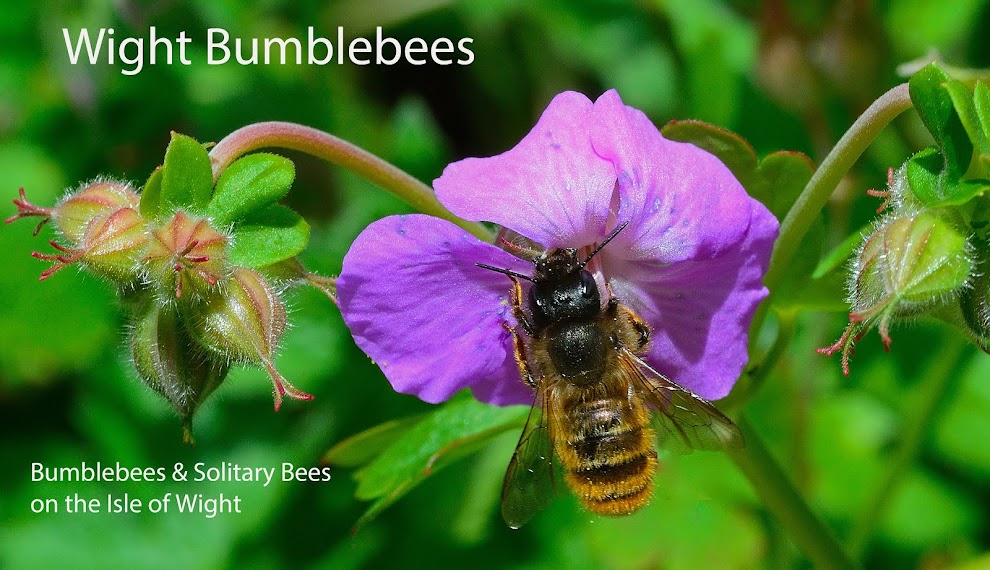
A male Red Mason Bee at Freshwater Bay.

Tuesday, 14 March 2017

Bees Out in the Spring Sunshine.

We enjoyed spring like weather on Monday with temperatures above the average for this time of year.Consequently all types of insects responded to the warmth and I was pleased to see my first Bee-fly of the year.The Dark-edged Bee-fly or Large Bee-fly (Bombylius major) is common here and mimics a small bumblebee.
Queen bumblebees are also out and about with this Buff-tailed Bumblebee carrying a group of mites in need of a new home.Mites are normally harmless to the bee as they feed on wax,pollen,debris and small insects found in the formers nest.


Saturday, 23 July 2016

Gypsy Cuckoo Bumblebee.

The Gypsy Cuckoo Bumblebee Bombus bohemicus, parasites the nest of the White-tailed Bumblebee.It is  widespread in the UK but tends to be more common in the north.
BWARS states that; After emerging from hibernation during April the mated female seeks out  a B. lucorum nest containing a few workers.The female enters the nest and hides until it acquires the nest scent.It then kills or dominates the host queen and begins to lay eggs.Only B. bohemicus male and female eggs are hatched although all work in the colony is done by the host workers. 


Friday, 17 June 2016

Looking Good in the Rain.

This very dapper male Early Bumblebee was spotted yesterday in my local wood resting on a reed leaf waiting for the rain to stop.


Wednesday, 15 June 2016

Bee In Clover.

While on holiday on the Greek Island of Lefkada recently this solitary bee was observed on clover.Being completely ignorant  of bees from Greece I took advice,.and  it is suggested that it may be from the Halictine family or a large Lasioglossum.


Saturday, 7 May 2016

On The Lookout.

Along the banks of my local stream  mingled between the bluebells and wild garlic are small patches of bare ground.Dotted here and there are the telltale signs of minute nest holes made by mining bees.Nomad bees can be observed flying around and occasionally landing to perhaps lay an egg in the nest. 
There are  up to thirty species of nomad bee in the UK and they are particularly common in the south of England. The nomad bee pictured is considered to be Nomada flava,the Flavous Nomad.


Tuesday, 26 April 2016

A Personal Favourite.

The fabulous Red-tailed Bumblebee Bombus lapidarius, is a particular favourite of mine.It is a common bumblebee and nests in a hole in the ground,sometimes under stones or at the base of a dry stone wall,hence their other common name the Stone Bumblebee.The queen pictured below emerges from hibernation in March.When the similar but much smaller workers hatch from the nest they take over pollen collecting duties while the queen concentrates on laying more eggs.An individual nest can have up to 200 bees and later in the year the males emerge.Only the newly hatched queens survive at the end of the season to hibernate and  create a colony the next spring.


Thursday, 21 April 2016

Andrena cineraria.

An unmistakable solitary bee  seen at this time of the year is the Ashy Mining Bee,Andrena cineraria. A common bee in Britain and obvious by its black and ashy-grey markings.The females are black with two broad grey hairbands across the thorax,The males are similar,but the thorax is completely clothed with less dense grey hairs.In addition the male has a noticeable tuft of white hairs on the lower face.
This female pictured below appeared on the front passenger seat of my car and was happy to allow itself to be placed on a suitable leaf.