The final bee of the year to emerge is the Ivy Bee Colletes hederae.It's life cycle has been mentioned in this blog before,as it is a solitary bee found mainly here in seaside cliff burrows. An ivy bush is now in full flower in our garden and the bee along with many hoverflies are gathering it's pollen
Title Photo
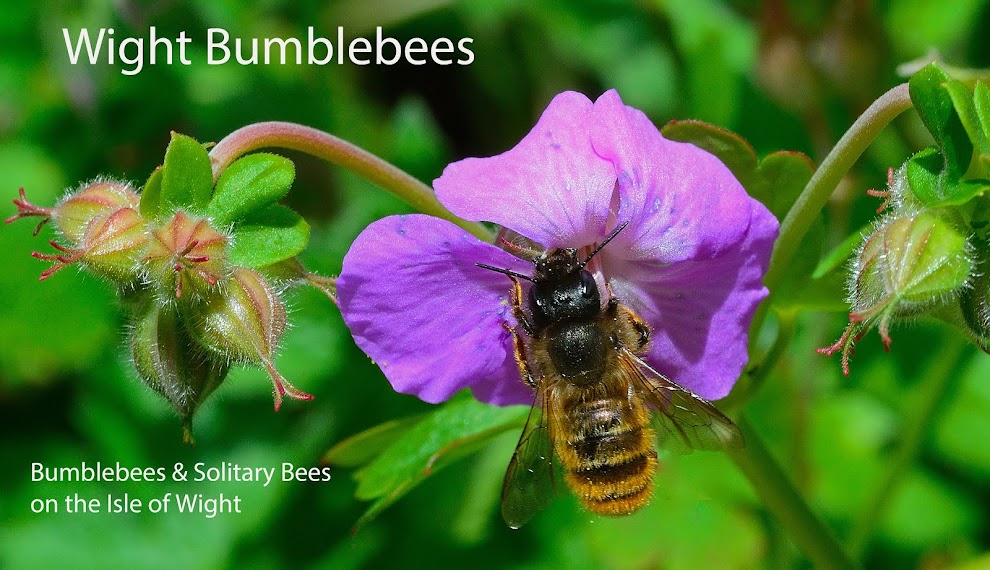
A male Red Mason Bee at Freshwater Bay.
Sunday, 4 October 2026
Tuesday, 30 March 2021
The Parasitic Species on our Coastal Cliffs.
The crumbling cliffs and resulting landslip habitat of our south-west coast is perhaps a stronghold in Southern England of two parasitic species of solitary bees. Firstly the large and flightless Oil Beetle, Meloe proscarabaeus. Its lifestyle is referred to in my earlier post of the 30th April 2017 entitled Oil Beetles.The second species is the Dotted Bee-fly Bombylius discolor. This bee-fly also has a strong connection with solitary bees and wasps. Its lifecycle is explained in my post of the 1st April 2016 Bombylius discolor.
Both these were encountered yesterday on the cliffs.
Saturday, 28 March 2020
Solitary Bees Busy on the Fruit Blossoms.
The few days of settled sunny weather has seen many bees out and about.In particular foraging solitary bees on the early flowering plants.Our plum tree is now in full bloom and female Yellow-legged Mining Bees Andrena flavipes,were busy gathering pollen,as seen below in the first two photos.The third individual is as yet unidentified.

Friday, 3 January 2020
Bumblebees Busy in the Winter Garden.
The first sunny day of 2020 and Buff-tailed Bumblebees are buzzing in my garden around the flowering Mahonia shrub.Along with other flowering plants at this time of year this nectar enables species such as the Buff-tailed to remain active throughout the winter together with the mild temperatures in the south of England.The following photo's are of a worker bumblebee,probably one of up to one hundred at a winter colony maintained by the queen bumblebee.
Monday, 30 September 2019
A Megachilidae Bee on Meganissi.
A solitary bee seen on the Greek Island of Meganissi in May was this rather demonic looking bee.The best identification I can make is a member of the Megachilidae family of bees,more commonly known as Mason,Leafcutter,and Resin bees.Further enquires have found it to be subgenus chalicodoma.
Saturday, 15 June 2019
Another Sight of the Violet Carpenter Bee.
On my trips to the Greek Islands I sometimes have been lucky enough to see the Violet Carpenter Bee.It is mainly found in southern Europe and the queen in particular is unmistakable being perhaps one of the largest bee species.
Monday, 13 May 2019
Nomads Out & About..
At this time of the year Nomad bees are about,and this one was seen in my garden yesterday.It is considered to be Nomad flava and is widespread,particularly in southern England.More information on this species can be found here.

Subscribe to:
Posts (Atom)


