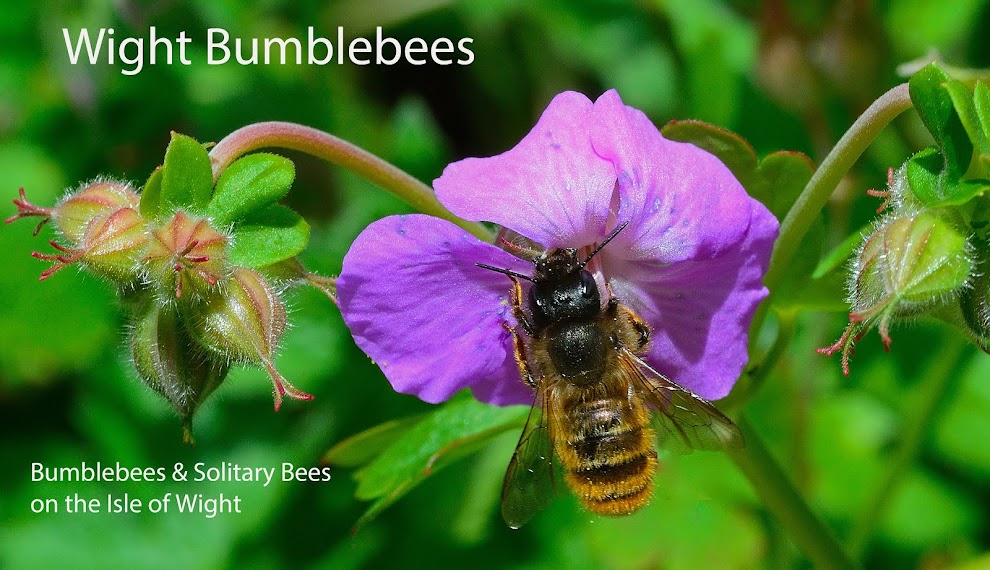
Title Photo

A male Red Mason Bee at Freshwater Bay.
Showing posts with label Bombus lucorum. Show all posts

Saturday, 23 July 2016

Gypsy Cuckoo Bumblebee.

The Gypsy Cuckoo Bumblebee Bombus bohemicus, parasites the nest of the White-tailed Bumblebee.It is  widespread in the UK but tends to be more common in the north.
BWARS states that; After emerging from hibernation during April the mated female seeks out  a B. lucorum nest containing a few workers.The female enters the nest and hides until it acquires the nest scent.It then kills or dominates the host queen and begins to lay eggs.Only B. bohemicus male and female eggs are hatched although all work in the colony is done by the host workers. 


Thursday, 7 August 2014

White-tailed Bumblebee.

Today I came across  several male White-tailed Bumblebees feeding on giant thistles in my local copse.
The White-tailed Bumblebee,Bombus lucorum,is a common and widespread species.The hibernating queens emerge in the spring and start a colony by laying a few eggs.These hatch into workers and later in the season the males and new females appear.Once mated the prospective queens will hibernate over the winter while the males die, together with the old queens in the autumn
The male can be identified by the yellow hair on the head and extra tufts on yellow hair on the thorax and abdomen.


.

Thursday, 10 April 2014

Bombus hortorum or Bombus jonellus

Again on my garden fence this morning were several bumblebees enjoying the morning sunshine.
This particular bumblebee caught my eye as it seemed to display two yellow bands on its thorax as opposed to the one band on the species Bombus terrestris and Bombus lucorum.This would indicate therefore that the bumblebee is the Garden Bombus hortorum or the Heath Bombus jonellus as both have the two bands.
A definite identification is normally seen in the shape of the face,more or less rounded in the case of the jonellus whereas hortorum is elongated.