Title Photo

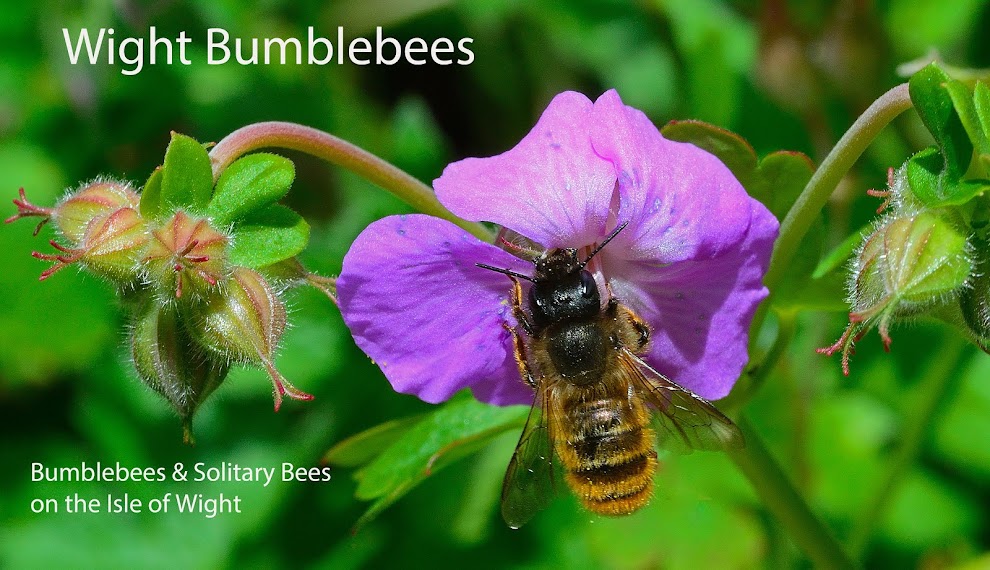
A male Red Mason Bee at Freshwater Bay.

Friday, 17 June 2016

Looking Good in the Rain.

This very dapper male Early Bumblebee was spotted yesterday in my local wood resting on a reed leaf waiting for the rain to stop.


Wednesday, 15 June 2016

Bee In Clover.

While on holiday on the Greek Island of Lefkada recently this solitary bee was observed on clover.Being completely ignorant  of bees from Greece I took advice,.and  it is suggested that it may be from the Halictine family or a large Lasioglossum.


Saturday, 7 May 2016

On The Lookout.

Along the banks of my local stream  mingled between the bluebells and wild garlic are small patches of bare ground.Dotted here and there are the telltale signs of minute nest holes made by mining bees.Nomad bees can be observed flying around and occasionally landing to perhaps lay an egg in the nest. 
There are  up to thirty species of nomad bee in the UK and they are particularly common in the south of England. The nomad bee pictured is considered to be Nomada flava,the Flavous Nomad.


Tuesday, 26 April 2016

A Personal Favourite.

The fabulous Red-tailed Bumblebee Bombus lapidarius, is a particular favourite of mine.It is a common bumblebee and nests in a hole in the ground,sometimes under stones or at the base of a dry stone wall,hence their other common name the Stone Bumblebee.The queen pictured below emerges from hibernation in March.When the similar but much smaller workers hatch from the nest they take over pollen collecting duties while the queen concentrates on laying more eggs.An individual nest can have up to 200 bees and later in the year the males emerge.Only the newly hatched queens survive at the end of the season to hibernate and  create a colony the next spring.


Thursday, 21 April 2016

Andrena cineraria.

An unmistakable solitary bee  seen at this time of the year is the Ashy Mining Bee,Andrena cineraria. A common bee in Britain and obvious by its black and ashy-grey markings.The females are black with two broad grey hairbands across the thorax,The males are similar,but the thorax is completely clothed with less dense grey hairs.In addition the male has a noticeable tuft of white hairs on the lower face.
This female pictured below appeared on the front passenger seat of my car and was happy to allow itself to be placed on a suitable leaf.


Tuesday, 19 April 2016

Osmia bicornis.

Osmia bicornis or Osmia rufa is commonly known as the Red Mason Bee.This male pictured below clearly shows the gingery (red) hairs which gives this species its name.It is widespread and can be seen from late March to early summer.


Thursday, 14 April 2016

Andrena flavipes.

The Yellow-legged Mining Bee,Andrena flavipes is an early spring solitary bee as mentioned in a recent previous post.That post featured a male,however now that pollen rich flowers are available this female  was noticed enjoying the Spanish bluebells Hyacinthoides hispanica.