This queen Tree Bumblebee, Bombus hypnorum, was spotted in my local copse today.It is one of the earliest bumblebees to be seen in the spring and can be said to be a 'woodland edge' species.However in the UK,where it has been resident since 2001,this bee likes to make use of nestboxes as well as tree holes,in which to create a nesting colony.
Title Photo
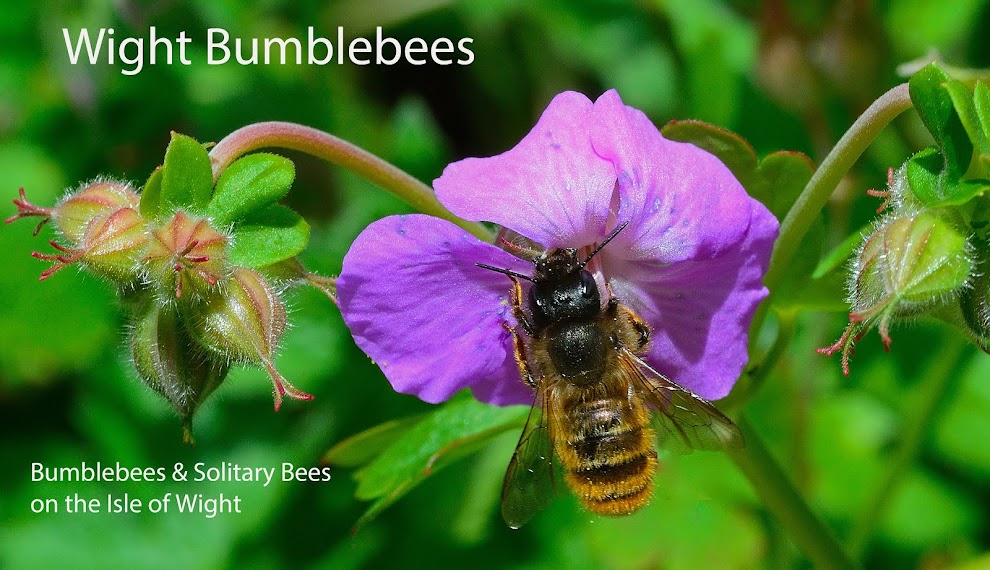
A male Red Mason Bee at Freshwater Bay.
Wednesday, 23 March 2016
Tuesday, 22 March 2016
The Yellow-legged Mining Bee.
A common spring solitary bee is Andrena flavipes or the Yellow-legged Mining Bee.It is numerous in Southern England and I came across several individuals yesterday on south facing chalk cliffs.
Andrena flavipes nests are constructed in the ground,
and are often found in dense aggregations in suitable,exposed
banks and cliffs, tended lawns, flower
beds, roadside verges and in sparsely vegetated field
margins.
In most areas where the bee is found, this Yellow-legged Mining Bee plays host to the cuckoo bee Nomada fucata.
.
Friday, 11 December 2015
Pine Honey.
While on holiday to the north-eastern Aegean Island of Thassos a visit was made to the Beekeeping Cooperative where the honey is processed and refined. It receives honey from over 100 family-run independent producers who are renowned for their dark caramel coloured pine honey.To give this honey it's delicious taste the bees feed on a white fungus that lives on the local pine trees, as pictured below.This fungus is available to the bees in August so it therefore prolongs the honey making season. The white cotton-like waxy secretion is made by an insect called Marchalina hellenica.
Once taken from the hive the honeycombs are scraped to remove the caps made by the bees to seal each cell. The frames are then placed in an extractor to separate the honey from the comb by spinning, which forces the liquid to the sides of the machine.Gravity then allows the honey to fall to the bottom of the extractor for collection.
After the honey is extracted,it is heated to aid the process of straining.This removes any remaining pieces of wax and any other particles.Finally the honey is bottled and labelled for sale, either to visitors on the premises or for distribution all over the Island and mainland Greece.
Tuesday, 20 October 2015
Here At Last.
A couple of days ago the first female Ivy Bees emerged from the cliff colony at Monks Bay.Yesterday the number of male bees flying around the nest holes had drastically diminished and several females were coming and going with their full pollen sacs.(Thanks to A.N.Other for the use of his photo of mating Ivy Bees)
![]() |
| The Ivy Bee coastal cliff colony at Monks Bay. |
Wednesday, 23 September 2015
Anticipation.
Another visit to my local colony of Ivy Bees today and the spectacle of hundreds of male bees buzzing around the nesting holes on the cliffs.No sign as yet it seems of the emerging females, despite the males investigating the nesting burrows and pouncing on any bees that may be near.They quickly realized that any bees that emerged from the burrows were investigating males.
Thursday, 17 September 2015
Ready and Waiting.
The Ivy Bee,Colletes hederae,is the last bee of the year to emerge as it feeds on the blossom of the Ivy.Now a resident in the UK since 2001 they are a mining bee,making use of soft sandy cliffs and banks for their nesting holes.The males are the first to appear,and at my local colony situated on south facing coastal cliffs they are now flying about awaiting the appearance of the females from their burrows.Once emerged the females are then mated and they begin to collect pollen for the eggs they have laid in their nest holes.These holes can be counted in hundreds on the cliff face and are up to 30cms in length.
Friday, 4 September 2015
A Little Lasioglossum.
This male Lasioglossum was one of many seen on the sandy cliffs at Bonchurch yesterday.Not more than a centimetre in length it is impossible to confirm the particular species.
In a short while these cliffs will be populated by the attractive Ivy Bee Colletes hederae.
Subscribe to:
Posts (Atom)


