Another visit to my local colony of Ivy Bees today and the spectacle of hundreds of male bees buzzing around the nesting holes on the cliffs.No sign as yet it seems of the emerging females, despite the males investigating the nesting burrows and pouncing on any bees that may be near.They quickly realized that any bees that emerged from the burrows were investigating males.
Title Photo
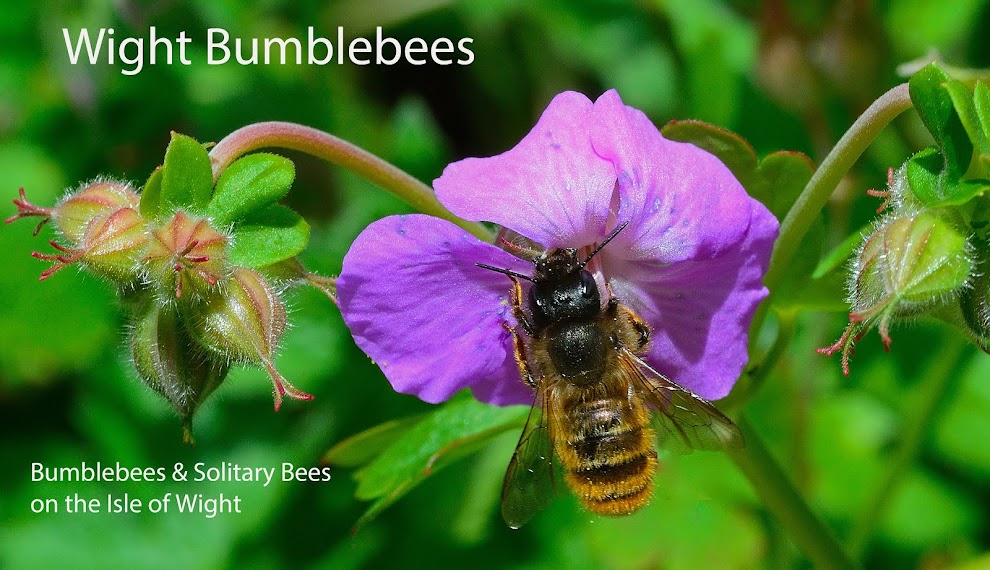
A male Red Mason Bee at Freshwater Bay.
Wednesday, 23 September 2015
Thursday, 17 September 2015
Ready and Waiting.
The Ivy Bee,Colletes hederae,is the last bee of the year to emerge as it feeds on the blossom of the Ivy.Now a resident in the UK since 2001 they are a mining bee,making use of soft sandy cliffs and banks for their nesting holes.The males are the first to appear,and at my local colony situated on south facing coastal cliffs they are now flying about awaiting the appearance of the females from their burrows.Once emerged the females are then mated and they begin to collect pollen for the eggs they have laid in their nest holes.These holes can be counted in hundreds on the cliff face and are up to 30cms in length.
Friday, 4 September 2015
A Little Lasioglossum.
This male Lasioglossum was one of many seen on the sandy cliffs at Bonchurch yesterday.Not more than a centimetre in length it is impossible to confirm the particular species.
In a short while these cliffs will be populated by the attractive Ivy Bee Colletes hederae.
Thursday, 20 August 2015
Europe's Largest Bee.
The Violet Carpenter Bee, Xylocopa violacea is a bee of southern Europe although sighting have been made in the UK.I have not been lucky enough as yet to see Europe's largest bee here on the Isle of Wight.Perhaps there would be a chance to see one on my latest holiday to the Greek Islands which took place last week although I had already come across this bee on the Greek Island of Lefkada in May. I was not disappointed as I was treated to two separate sightings despite the fact that by now the bees are showing some wear and tear and their wings have lost that lovely violet colouring.
Thursday, 11 June 2015
A Cuckoo Bumblebee.
The Southern Cuckoo Bumblebee,Bombus vestalis is one of three species of cuckoo bumblebee recorded on the Isle of Wight.This one pictured was seen on a giant thistle on the Islands' downland. Identifying a cuckoo from other common bumblebees can be tricky, however this particular genus has no pollen basket and the outer surface of the hind tibia has hairs.It will also be seen that the wings are quite dark.Another feature of the Psythirus i.e.Cuckoo Bumblebees is the very quiet buzz compared with other bumblebees.
Wednesday, 6 May 2015
Andrena carantonica.
This mining bee is seen from March to June and although it seems to have no common name it can be described as one of the larger mining bees.The bee is also known as Andrena scotica.The photo below of a female, does not confirm that this individual is an A.carantonica,however it would seem likely.
Andrena carantonica is one of the most common Andrena species in the UK, where it nests in sandy soils usually near to pathways.This is because they do not like to have their nests obstructed by overgrowing plants.There is one communal entrance used by the females that divides underground into separate chambers for each bee.
Wednesday, 29 April 2015
Garden Bumblebee.
The Garden Bumblebee.Bombus hortorum is a common bumblebee and I see it at this time of year in my garden.However this particular bee pictured below was discovered in my local copse feeding on Bugle flowers.This species has a very long tongue and prefers flowers with deep tubes.
Perhaps the best way to distinguish between B. hortorum and other species with similar banding,such as the Heath Bumblebee,is the shape of the face which is distinctly long in the case of B. hortorum.
Subscribe to:
Posts (Atom)


