Title Photo

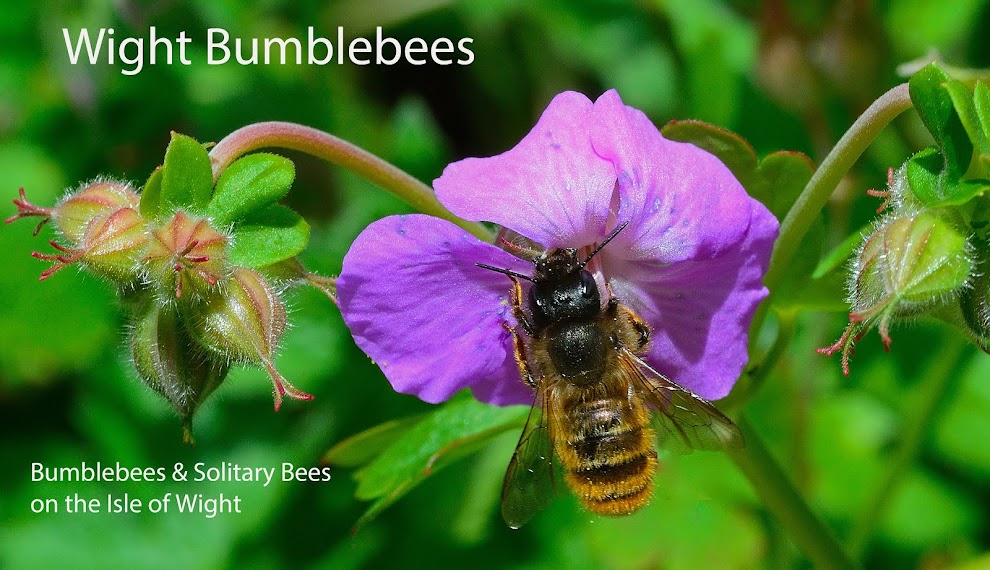
A male Red Mason Bee at Freshwater Bay.

Wednesday, 18 March 2015

Another Spring Bee.

The Tree Bumblebee, Bombus hypnorum,is one of the first bumblebees to appear in the spring.Ever since its arrival in the UK in 2001,this bee has spread northwards and a project is currently running to monitor its status in this country. Unusually for a bee this species nests in hollow trees and also in bird boxes.
Today I came across  this individual in my local copse busily collecting pollen from the newly emerging sallow flowers.Queens vary considerably in size although the workers are rather small. Colour can be quite variable and some have a very dark thorax.However they will always have a white tail.
The Tree Bumblebee can be extremely defensive of its nest site and should it be necessary to remove it great care should be taken as they can become very aggressive.Perhaps the best option should be to leave the colony to complete its annual life cycle and die out naturally. 
 .


The Bees,Wasps,and Ants Society (BWARS) is  monitoring the spread of the species in the UK and any sightings can be reported to the project on their website.The Tree Bumblebee is widespread on the continent and presumably its colonization here was a natural progression,maybe due to global warming.Maybe we can look forward to other continental species arriving in the UK because of  our changing climate.
Judging by the latest information this bumblebee has not yet reached Scotland or Ireland but it could only be a matter of time as its habit of nesting in bird boxes will no doubt speed its move north and west.
Like all bumblebees the queen can be seen 'nest searching'  in March and April,normally along walls,fencing,guttering and of course around bird box  entrances. Bombus hypnorum is generally out and about from early spring until June.
Once the nest is complete it is six weeks until the workers take over the foraging and  the nest maintenance  duties.A really healthy colony can have as many as 400 bees but usually they are less in number.A colony  can live for up to five months although others will end earlier due to the activity of the Wax Moth  Aphomia sociella who's caterpillars attack the nest. 


Tuesday, 17 March 2015

Build a Bee Hotel.

Now is a good time to provide a home for all sorts of insects and in particular solitary bees.So what could be better than a Bee Hotel.They are easy to make although I took the lazy way out and bought this one for £9..Depending on the size of your hotel it can be free standing or secured to a fence post or tree like mine.Best to be in a sunny spot facing in a southerly direction although sheltered as much as possible  from the rain.Once your mason bees take up residence they will seal the holes with mud so a supply of damp soil nearby will be a help.
All bees are fantastic pollinators and should be welcomed into our gardens.


Thursday, 12 March 2015

Overwintering Bombus Terrestris

Over the last twelve years or so,naturalists have noted winter activity by the Buff-tailed Bumblebee,Bombus terrestris, Workers have been seen foraging at a wide range of winter-flowering plants and males have also been reported flying in February. From this it is clear that a small number of mated queens now establish nests in the autumn and they can therefore exploit the increasing winter blooming plants in our parks and gardens.
Today I was fortunate enough to see this Buff-tailed worker in the company of a much larger Buff-tailed queen. Obviously this individual has overwintered in a nest created last autumn.


Thursday, 5 March 2015

Start of the New Season.

Now that the weather has become warmer and with the temperatures rising nicely the first Honeybees are buzzing around the garden in the sunshine.There are several hellebore plants in flower and  they are proving to be very popular with the Honeybees and a queen Buff-tailed bumblebee.
My first siting of the Buff-tailed was on the 21st February during a brief mild spell when I saw her with full pollen sacs.No doubt she was just out of hibernation and collecting supplies of pollen for her new nest.


Tuesday, 2 December 2014

Late Visitors.

The last couple of days of November were mild and sunny on the Island and it brought out the bees to feed on the mahonia which is flowering in our garden.This queen Buff-tailed Bumblebee,Bombus terrestris, is a late in the year visitor.
Another bee enjoying my mahoina was the Honeybee,Apis mellifera. Our native honeybee is active all the year round as the workers ensure that enough pollen is collected to provide honey in the hive for the colony to sustain it through the winter.Of course when conditions are suitable and flowers available the bee will collect more pollen at any time.


Friday, 31 October 2014

Colletes hederae.

The Ivy Bee is a very recent arrival in the UK.The first report of this bee was in 2001 and since then it has spread along the south coast of England and north to Wales and towards the Midlands.
As the name suggests this species likes the pollen of the ivy and consequently it is seen in September and October when the ivy is in flower
Today I spent a very pleasant time watching these bees coming and going from their burrows that are excavated into the soft cliffs.There must have been hundreds of small holes at this site, situated on south facing cliffs near to Wheelers Bay at Bonchurch.


Wednesday, 1 October 2014

The Male Lasioglossum leucozonium.

This rather worn male Lasioglossum leucozonium is seen feeding on Devil's-bit Scabious. The males appear from July onwards although the females are seen as early as mid-March.
It is a common and widespread species found in England and Wales on mainly sandy and calcareous soils