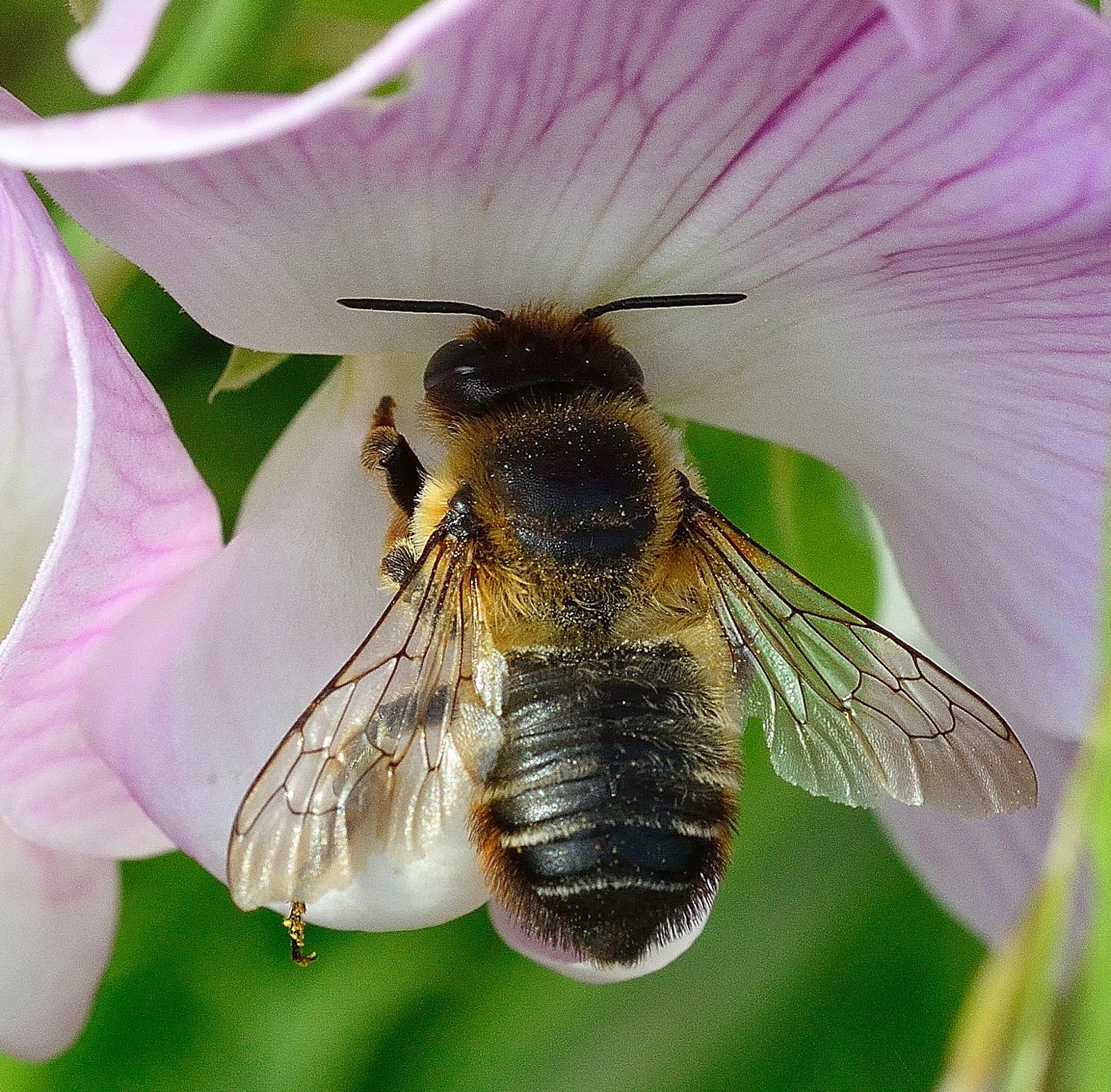
Title Photo

A male Red Mason Bee at Freshwater Bay.

Wednesday, 24 September 2014

Devil's-bit Scabious.

Now that the Common Fleabane is as good as over in my local copse,insects and in particular bees are all over the Devil's-bit Scabious flowers.This common plant prefers damp woodland.The flowers are violet,sometimes white and unlike those of the Field and Small Scabious the outer flowers are not noticeably bigger than the inner ones.


Friday, 5 September 2014

Lasioglossum leucozonium.

This small solitary mining bee is widespread in England.They are particularly attracted to yellow flowers as in the following photos where they are feeding on Common Fleabane.However thistles and other plants are frequented.
This species is found mainly in sandy and calcareous areas and the nest is dug by the female in light soil. Although a solitary bee females have been known to construct their nests in the same burrows.


Wednesday, 3 September 2014

In my Local Copse.

The warm and sunny weather returned today and many insects were enjoying the drifts of Common Fleabane,Pulicara dysenterica, that are now covering the open paths of my local copse.
The Honeybee,Apis mellifera,in particular, is fond of fleabane and they were out in force collecting 'basket fulls' of pollen.Known as the Western or European Honeybee it is our only native honeybee species.
Several  bumblebee species were also out and about including the Red-tailed Bumblebee on Field Scabious and Thistle.The following photographs show a male Red-tailed,Bombus lapidarius.


Wednesday, 27 August 2014

Bombus Pascuorom

The Common Carder Bee is one of our most common bees and can be seen from spring until November in all types of habitat.
The French Lavender flowers in my garden are proving very popular for this species at the moment.


Thursday, 7 August 2014

White-tailed Bumblebee.

Today I came across  several male White-tailed Bumblebees feeding on giant thistles in my local copse.
The White-tailed Bumblebee,Bombus lucorum,is a common and widespread species.The hibernating queens emerge in the spring and start a colony by laying a few eggs.These hatch into workers and later in the season the males and new females appear.Once mated the prospective queens will hibernate over the winter while the males die, together with the old queens in the autumn
The male can be identified by the yellow hair on the head and extra tufts on yellow hair on the thorax and abdomen.


.

Friday, 1 August 2014

Leaf-cutter Bee.

The Leaf-cutter Bee,Megachile, nests in dead wood,holes in plant stems,cliffs,and old walls.They cut out discs of leaves,particularly from roses,and glue them together using saliva to build cells in which their larvae live
The Leaf-cutter Bee can be seen from late spring to August and feeds solely on pollen and nectar.
This bee could be mistaken for a Honey Bee although the underside of the abdomen is orange.There are seven extant species of leaf-cutter bee in the UK which are very difficult to tell apart.It is a common species in the south of England.
The male does not collect pollen and the following photos are of a female.They collect pollen in pollen baskets that are situated on the underside of the abdomen.

.


i
.
Friday, 20 June 2014

The Bee Orchid.

This beautiful orchid is now to be seen in our woods and copse.Bee orchids (Ophrys apifera) are easily identifiable by their eye-catching flowers, which are present during June and July. The attractive flowers mimic an insect feeding on a flower – with a furry lip that looks like the body of a bee, 2 sepals (the outermost parts of a flower) that look like antennae and another 3 outer sepals that resemble large pink petals.
As a result of this deception and an attractive scent, male bees try to mate with the lip of the flower (known as pseudocopulation). This mimicry has been favoured by natural selection because the bees unwittingly bring about pollination of the orchids by transferring pollen to the female parts of the next flower they visit.
Bee orchids don’t depend on bees to reproduce, however, and in Britain they are generally self-pollinated. But the closely related fly orchid (Ophrys insectifera), early spider orchid (Ophrys sphegodes) and late spider orchid (Ophrys fuciflora) are reliant on their insect pollinators and also lure them with fake signals.