Following yesterdays sunny spell of weather today has turned cloudy and cold. A walk in the garden led to the discovery of a queen Red-tailed bumblebee seemingly in distress at the base of our full flowering barberry bush.Of course the bee was fine as it is just having a rest.However she could well do with some sort of reviving in order to continue her pollen collecting.So a small mixture of clean water and sugar proved to be just the ticket. Almost immediately she moved onto the saucer and seemed to enjoy the feed.Revived she then crawled off and disappeared into the border.
Thursday, 12 April 2018


Wednesday, 11 April 2018
Spring Species Now Appearing.
Now that the temperatures are slowly on the way up and there is at last more in the way of sunshine an increasing number of springtime bees are to be seen in the garden.Yesterday this female Yellow-legged Mining Bee,Andrena flavipes, found a sunny spot on a bamboo leaf.This is a common solitary bee here at this time of year and is restricted to the south of Britain.
Also on show was a male Andrena bee of a species that I was unable to identify.
Also on show was a male Andrena bee of a species that I was unable to identify.


 |
| A male Andrena,species not known |
Monday, 26 March 2018
Bees Respond to the Spring Sunshine.
Spring was in the air today albeit briefly and at my local copse quite a few queen bumblebees were on the move.Among the several Buff and White-tailed bumbles seen flying around was this Early Bumblebee.It is my first sighting of the year of this attractive bumblebee.She was very interested in the moss which covered a tree stump.

Friday, 16 March 2018
The Belated Spring Weather Brings Out the Bees.
Good to see this Queen Tree Bumblebee(Bombus hypnorum) in my local copse yesterday.Let's hope that the spring weather is here to stay and our bees can get down to work.


Sunday, 30 April 2017
Oil Beetles.
These large flightless beetles are dependent on the solitary bee to complete its lifecycle.The female will dig a nesting burrow close to a bee colony.The hatched larvae known as tringulins, will then climb up to reach flowers where their hook- like forelegs enable the larvae to attach themselves to visiting bees.The aim is to be taken by the bee to its nesting burrow where it feeds on the bees' egg and pollen store.Finally it pupates in the burrow over the winter and emerges as an adult beetle the following year.
Meloe proscarabaeus or the Oil Beetle as it is commonly known gets this name by releasing a pungent oily liquid in defence when threatened.It is suffering a steady decline in population and is currently a BAP species(Biodiversity Action Plan).The female beetle is larger than the male and the following photo shows the difference in size of the sexes.

Wednesday, 19 April 2017
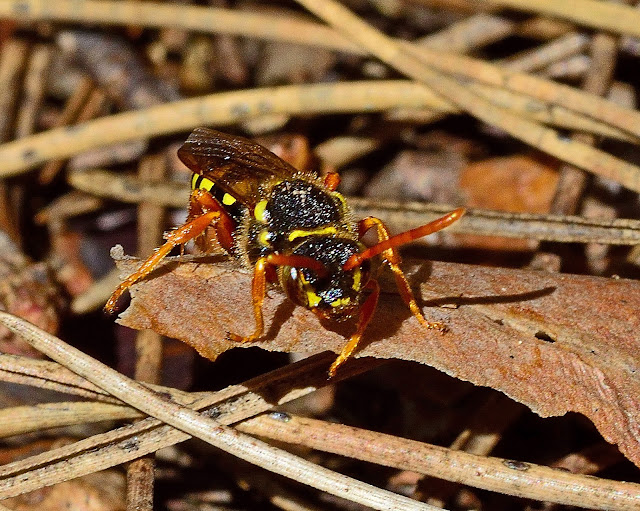
Nomada goodeniana.
On a sunny patch of bare ground at the foot of a conifer in my local forest I found several nomad bees busily searching for solitary bee holes in which to lay their eggs.The nomad bee pictured below had just reappeared from under a pine cone where no doubt one such nest was located.This species of nomad bee is Nomada goodeniana seen mainly from April to June.It is a widespread cuckoo bee in the UK and preys on nests of the Andrena nigroaenea- group.It is one of the largest of our Nomada species.


Tuesday, 14 March 2017
Bees Out in the Spring Sunshine.
We enjoyed spring like weather on Monday with temperatures above the average for this time of year.Consequently all types of insects responded to the warmth and I was pleased to see my first Bee-fly of the year.The Dark-edged Bee-fly or Large Bee-fly (Bombylius major) is common here and mimics a small bumblebee.
Queen bumblebees are also out and about with this Buff-tailed Bumblebee carrying a group of mites in need of a new home.Mites are normally harmless to the bee as they feed on wax,pollen,debris and small insects found in the formers nest.


Subscribe to:
Posts (Atom)