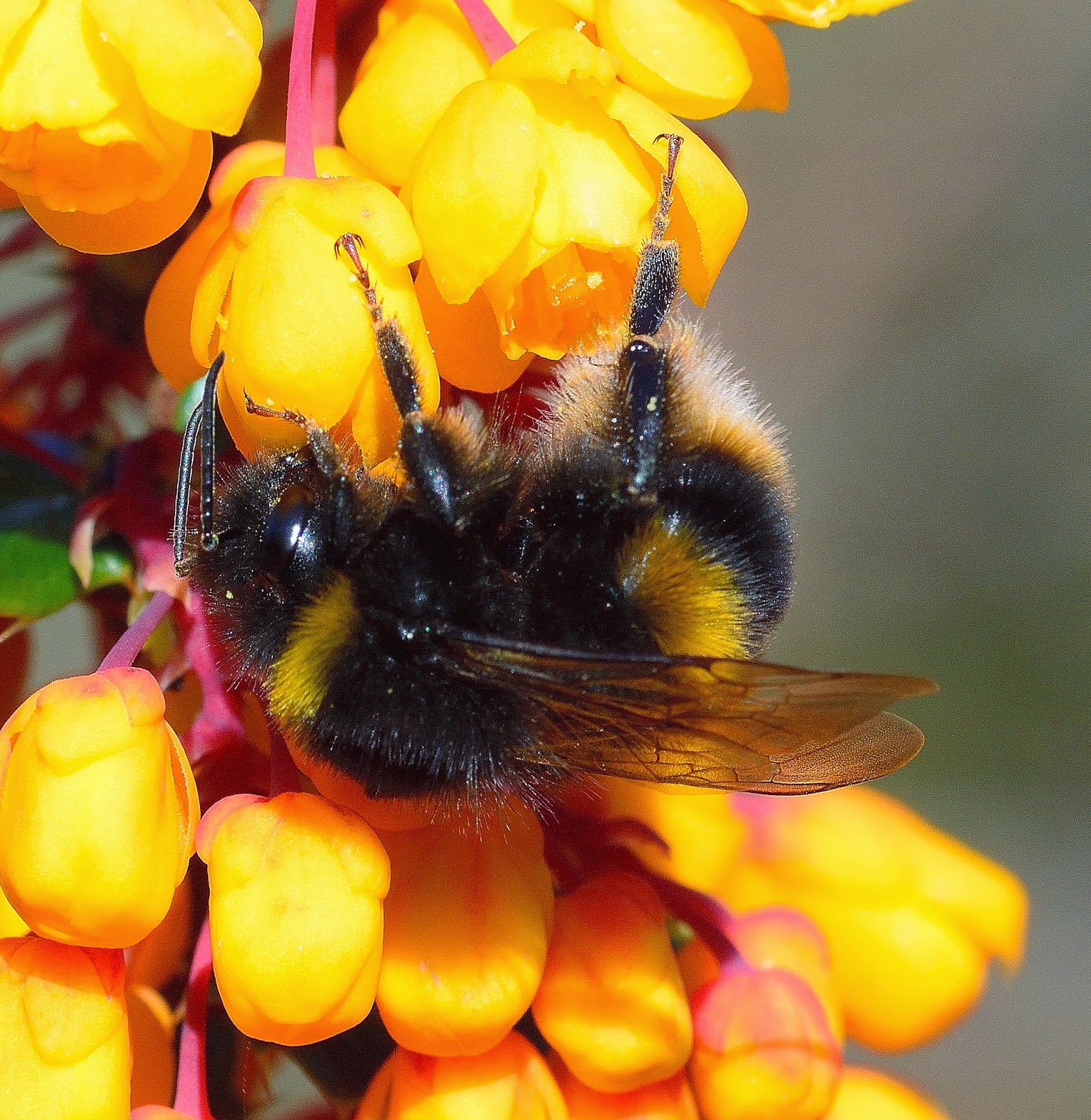
The first sunny day of 2020 and Buff-tailed Bumblebees are buzzing in my garden around the flowering Mahonia shrub.Along with other flowering plants at this time of year this nectar enables species such as the Buff-tailed to remain active throughout the winter together with the mild temperatures in the south of England.The following photo's are of a worker bumblebee,probably one of up to one hundred at a winter colony maintained by the queen bumblebee.
Title Photo
A male Red Mason Bee at Freshwater Bay.
Showing posts with label Buff-tailed. Show all posts
Friday, 3 January 2020
Thursday, 14 February 2019
First Bumblebee Sighting of the year.
We are now enjoying a few days of mild and settled weather and spring it seems is just around the corner.Therefore I was pleased to see my first bumblebee of the year,a Buff-tailed Bumblebee (Bombus terrestris) busily buzzing in and out of our garden hellebores this morning.
Monday, 26 March 2018
Bees Respond to the Spring Sunshine.
Spring was in the air today albeit briefly and at my local copse quite a few queen bumblebees were on the move.Among the several Buff and White-tailed bumbles seen flying around was this Early Bumblebee.It is my first sighting of the year of this attractive bumblebee.She was very interested in the moss which covered a tree stump.
Tuesday, 14 March 2017
Bees Out in the Spring Sunshine.
We enjoyed spring like weather on Monday with temperatures above the average for this time of year.Consequently all types of insects responded to the warmth and I was pleased to see my first Bee-fly of the year.The Dark-edged Bee-fly or Large Bee-fly (Bombylius major) is common here and mimics a small bumblebee.
Queen bumblebees are also out and about with this Buff-tailed Bumblebee carrying a group of mites in need of a new home.Mites are normally harmless to the bee as they feed on wax,pollen,debris and small insects found in the formers nest.
Thursday, 12 March 2015
Overwintering Bombus Terrestris
Over the last twelve years or so,naturalists have noted winter activity by the Buff-tailed Bumblebee,Bombus terrestris, Workers have been seen foraging at a wide range of winter-flowering plants and males have also been reported flying in February. From this it is clear that a small number of mated queens now establish nests in the autumn and they can therefore exploit the increasing winter blooming plants in our parks and gardens.
Today I was fortunate enough to see this Buff-tailed worker in the company of a much larger Buff-tailed queen. Obviously this individual has overwintered in a nest created last autumn.
Thursday, 5 March 2015
Start of the New Season.
Now that the weather has become warmer and with the temperatures rising nicely the first Honeybees are buzzing around the garden in the sunshine.There are several hellebore plants in flower and they are proving to be very popular with the Honeybees and a queen Buff-tailed bumblebee.
My first siting of the Buff-tailed was on the 21st February during a brief mild spell when I saw her with full pollen sacs.No doubt she was just out of hibernation and collecting supplies of pollen for her new nest.
Tuesday, 2 December 2014
Late Visitors.
The last couple of days of November were mild and sunny on the Island and it brought out the bees to feed on the mahonia which is flowering in our garden.This queen Buff-tailed Bumblebee,Bombus terrestris, is a late in the year visitor.
Another bee enjoying my mahoina was the Honeybee,Apis mellifera. Our native honeybee is active all the year round as the workers ensure that enough pollen is collected to provide honey in the hive for the colony to sustain it through the winter.Of course when conditions are suitable and flowers available the bee will collect more pollen at any time.
Saturday, 14 June 2014
The Cuckoo Bumblebees.
Of the six Cuckoo Bumblebees found in the UK three have been recorded on the Isle of Wight.
One of these three is the Vestal Cuckoo or Southern Cuckoo Bumblebee,Bombus vestalis.This species is known to parasitise the nests of the Buff-tailed Bumblebee,Bombus terrestris.
Both males and females can be identified by the narrow yellow patches at the base of the white tail.
Thursday, 3 April 2014
A Popular Spot.
I have found that my garden fence is a very popular place for bumblebees and indeed other insects to sun themselves.It faces towards the morning sun so is a good spot to warm up.
Today several bumblebees were making use of it including Red-tailed and a Buff or White-tailed worker.
Wednesday, 26 March 2014
Workers on the Job.
The worker bumblebees have now started to appear.Maybe the first ones are the Buff-tailed Bombus terrerstris as this species is normally the earliest of the year.The workers are smaller than the queen and have a white tail with a subtle buff line seperating the tail from the abdomen.
Saturday, 22 March 2014
Garden Visitors
Along with the early flowering Hellebore we have a Barberry in our garden which is just bursting into bloom.It is a magnet for all kinds of insects,especially bees. Today's visitors to the shrub were Honeybees Apis mellifera as well as Tree,Buff-tailed,and Red-tailed Bumblebees
..
Early Risers
Maybe the first bumblebee to see in any season will be the Buff-tailed Bombus terrestris.Also known as the Large Earth Bumblebee,the bee nests in the ground sometimes in old mouse holes.Colony is normally a minimum of 100 bees and can be up to 600.One of the most common bees in the UK.
Subscribe to:
Posts (Atom)